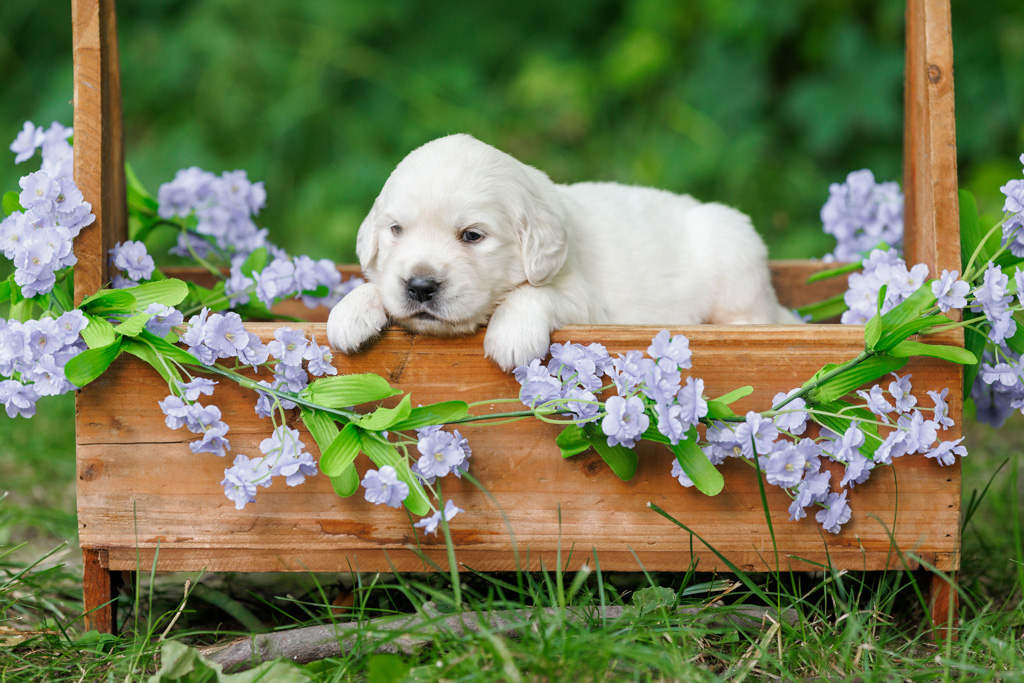
A busy home can be a wonderful place for an English Cream Golden Retriever.
There may be children moving from one activity to the next, visitors coming through the door, another pet nearby, and a family calendar that rarely seems to slow down. To a Golden who loves being part of family life, all of that activity can mean more companionship, more experiences, and more opportunities to feel included.
Of course, a full household can also be a lot for a young dog to process.
Puppies do not automatically know when to join the fun, when to settle, or how to handle every new sound and person calmly. Those skills develop through routine, training, thoughtful exposure, and plenty of rest.
Helping your Golden thrive is not about making your household quieter or organizing every day around the dog. It is about giving your dog enough predictability and guidance to feel secure, even when family life is moving quickly.
With the right foundation, an English Cream Golden Retriever can become more than comfortable in a busy home. They can become part of the rhythm that makes it feel like home.
Give Your Golden a Few Predictable Parts of the Day
Busy families rarely follow the exact same schedule every day. Practices run late, meetings move, guests arrive, and weekend plans change.
Your dog does not need every hour to happen on a strict timetable, but a few reliable touchpoints can make the day easier to understand.
Meals, potty breaks, morning activity, evening family time, and bedtime can serve as familiar anchors. When those parts of the day remain reasonably consistent, your Golden has a better sense of what to expect, even when everything between them changes.
Predictability can be especially helpful for puppies. A young dog who knows that play is followed by rest, or that dinner is followed by a calm evening routine, has an easier time moving from one activity to another.
This does not require a color-coded puppy calendar. It simply means creating a rhythm your family can realistically maintain.
Make Rest Part of the Plan
One of the easiest mistakes to make in an active household is assuming a puppy will sleep when they are tired.
Sometimes they will. Other times, they will keep following the children, investigating every sound, and trying to participate until they become overtired.
An overtired puppy may look as though they have too much energy. They may become mouthier, more impulsive, less responsive, or suddenly unable to settle. Puppies commonly need far more sleep than families expect, and regular opportunities to rest support healthy development and behavior.
Your Golden should have a comfortable place where activity slows down. That may be a crate, exercise pen, dog bed, or quiet room that the family treats as a place for rest rather than play.
A calm resting area does not need to be isolated from everyone. Many dogs settle best when they can still hear or see the family without being in the center of every activity.
Teaching children to respect that space matters, too. When the dog is resting, eating, or enjoying a chew, they should be allowed to do so without being hugged, climbed on, or repeatedly called back into the action.
Rest is not your puppy “missing out.”
It is part of what allows them to enjoy the next round of family activity without becoming overwhelmed.
Include Your Dog Without Making Them the Center of Everything
English Cream Golden Retrievers often enjoy being near their people. That does not mean they need to be actively entertained every moment the family is home.
Inclusion can be simple.
Your Golden may rest near the kitchen while dinner is prepared, join the family for a walk after school, or settle on a bed while everyone watches a movie. These ordinary moments help a dog feel connected without creating the expectation that every person entering the room will provide attention.
This balance is valuable in a busy home. Your dog learns that being part of the family sometimes means playing and interacting, while other times it means relaxing nearby.
Over time, that understanding can make daily life feel far more natural. The dog is not waiting for the next burst of entertainment. They are comfortable simply belonging.
Build Training Into Things Your Family Already Does
Training becomes much easier to maintain when it is woven into daily routines.
You do not always need a formal session with a treat pouch and fifteen uninterrupted minutes. Many of the most useful behaviors can be practiced during moments that already happen throughout the day.
Your Golden can wait briefly before going through the door, sit while the leash is attached, settle on a bed during dinner, or practice a calm greeting when someone arrives. A short recall game in the yard or a few repetitions of “place” while the family is moving around can reinforce important skills without adding another major task to the calendar.
Golden Retrievers are generally intelligent, eager to please, and responsive to training, but those qualities still need direction and consistency. A puppy that receives one set of expectations from one family member and completely different rules from another may struggle to understand what works.
Families do not need to handle every situation the same way, but it helps to agree on the basics. Decide which words you will use for common cues, whether the dog is allowed on furniture, and how everyone should respond to jumping, mouthing, or attention-seeking.
Clear expectations help your puppy succeed more quickly.
Give Your Golden Something Meaningful to Do
A busy household can provide plenty of stimulation, but stimulation and enrichment are not always the same thing.
Children running through the house, the television playing, and people opening doors create activity. They do not necessarily give your dog a satisfying way to use their brain.
English Cream Golden Retrievers benefit from purposeful engagement. Short training sessions, retrieving games, food puzzles, scent activities, and sniffing walks all give the dog a job to focus on.
Mental enrichment does not need to be elaborate. You can hide a few pieces of food around a safe room, practice finding a favorite toy, or let your Golden spend extra time investigating scents during a walk. Even a few minutes of reward-based training can provide useful mental activity.
This kind of engagement often helps dogs settle more comfortably afterward because they have done more than move their bodies. They have had an opportunity to think, explore, and work with their people.
Teach Calmness While Life Is Happening
It is easy to practice calm behavior when the house is already quiet. The more useful skill is learning how to settle while normal life continues nearby.
Begin during manageable moments. Ask your puppy to relax on a bed while one or two family members move through the room. Reward them for remaining there, then release them before they become frustrated.
As the behavior improves, you can gradually add everyday distractions. Someone may walk through the room, open a cabinet, or sit down at the table. The goal is not to test your puppy with the most chaotic situation possible. It is to build the skill slowly enough that they continue to succeed.
This is where a cue such as “place” can become especially helpful. It gives your dog a clear answer when they are unsure what to do during meals, deliveries, visits, or busy transitions.
Majestic Manor Goldens’ Good Puppy Citizen training program includes place training, crate conditioning, calm vehicle travel, handling skills, and working around distractions. These are practical skills that can make the transition into an active household feel more manageable.
Training provides a strong beginning, but families still need to maintain those behaviors after the puppy comes home. The handoff is not the end of training. It is the point where those skills become part of everyday family life.
Prepare for Visitors Before the Doorbell Rings
Many English Cream Golden Retrievers are naturally social, which can make visitors very exciting.
If every guest leads to jumping, racing, and immediate attention, those greetings can become harder to manage as your puppy grows. It is much easier to establish a routine early.
Before opening the door, give your dog a clear place to be. That may mean waiting behind a gate, resting in a crate with a safe chew, or practicing “place” until the first burst of excitement passes.
Once your Golden is calmer, they can greet the visitor in a more controlled way.
Guests should understand the plan as well. A well-meaning friend who immediately encourages jumping can undo the lesson your puppy is trying to learn. Ask visitors to wait until all four paws are on the floor before offering attention.
There will be imperfect greetings. That is part of raising a puppy. The goal is simply to make calm behavior more rewarding and repeatable than chaos.
Help Children and Puppies Learn Together
Golden Retrievers are often valued as family companions, but a good relationship between children and dogs still requires adult guidance.
Young children should always be supervised around dogs, regardless of how gentle or well-trained the dog may be. Children also need help understanding that a puppy is not a stuffed animal or a constant playmate.
Teach children how to invite the dog to interact rather than cornering or grabbing them. Show them how to recognize when the puppy is resting, moving away, or ready for a break. Calm petting, supervised training games, and helping with age-appropriate care can all strengthen the relationship.
Children may enjoy placing the food bowl down after an adult prepares it, tossing treats during a simple training exercise, or helping gather toys at the end of the day. These moments allow them to participate without placing responsibility for the dog entirely on their shoulders.
The adults remain responsible for care, training, safety, and supervision. Children can be part of the process, but they should not be expected to manage a growing puppy on their own.
Make Room for Independence
A dog can be deeply connected to the family and still learn how to rest independently.
This matters in homes where someone is usually present. Without practice, a puppy may become accustomed to following people all day and struggle when the household eventually becomes quiet.
Create short, positive opportunities for your Golden to settle without direct attention. They may rest in the crate while you work in another room, enjoy a safe chew behind a gate, or nap on their bed while the family is occupied.
The purpose is not to exclude the puppy. It is to teach them that they remain safe and secure when no one is actively interacting with them.
A healthy bond should provide reassurance, not create a need for constant proximity.
Watch What Your Dog Is Telling You
A thriving dog is not one who participates in every activity without ever needing a break.
Dogs communicate discomfort and stress through body language. Looking away, repeated lip licking, yawning when not tired, tucked ears, avoiding interaction, or leaving the area may signal that a dog needs more space.
In a busy home, those signals can be easy to miss.
Pay attention to what happens before your dog becomes restless or overwhelmed. Do they struggle most when several children are playing nearby? Do visitors make it difficult to settle? Does evening activity coincide with overtired puppy behavior?
Once you recognize the pattern, you can adjust the environment before the situation escalates. A nap, a quieter room, a shorter interaction, or a familiar cue may be all your dog needs.
Listening to those signals does not make your dog fragile. It helps them trust that their family will respond when they need support.
Remember That Every Golden Is an Individual
English Cream Golden Retrievers share many qualities people love about the breed, but no two dogs will respond to household activity in exactly the same way.
One puppy may happily nap through a noisy afternoon. Another may need more help disengaging from the action. One adult dog may enjoy greeting every visitor, while another prefers to observe before joining in.
Age matters too. A young puppy needs more sleep, supervision, and frequent potty breaks. An adolescent may have greater stamina but still needs help with impulse control. A mature Golden may understand the family rhythm beautifully while continuing to benefit from exercise, enrichment, and predictable routines.
Thriving does not mean your dog needs to fit a single picture of the perfect family companion. It means your household learns who your dog is and gives them what they need to feel confident within it.
A Busy Home Can Be a Beautiful Place to Grow Up
Your household does not have to become perfectly quiet for your Golden to be happy.
A full home can offer companionship, variety, play, affection, and a lifetime of shared experiences. The important part is making sure your dog has structure within the activity and rest within the excitement.
Give them clear expectations. Include them in ordinary family life. Protect their downtime. Offer meaningful activity, not just noise. Help every person in the home participate consistently and respectfully.
When those pieces come together, an English Cream Golden Retriever does not simply learn to tolerate a busy household.
They become part of what makes it feel warm, connected, and complete.
Frequently Asked Questions
Are English Cream Golden Retrievers good for busy families?
English Cream Golden Retrievers can do very well in active households when they receive consistent training, appropriate exercise, mental enrichment, rest, and regular connection with their people. Individual temperament and the family’s ability to meet the dog’s needs still matter.
How can I help my Golden puppy calm down in a busy home?
Start with predictable routines, regular naps, short training sessions, and a quiet resting space. Practice calm behaviors during manageable household activities rather than waiting until the environment is at its busiest.
Does a busy household provide enough stimulation on its own?
Not necessarily. Household noise and movement may keep a dog alert, but purposeful enrichment gives them a constructive way to use their mind. Training, scent games, retrieving, food puzzles, and sniffing walks can all add meaningful engagement.
Should my Golden have a space away from the family?
Yes. A comfortable crate, bed, pen, or quiet room gives your dog a place to rest without being disturbed. The space should feel safe and positive rather than being used only when the dog has done something wrong.
How should children interact with a Golden Retriever puppy?
Children should be supervised and taught to use gentle handling, respect rest and feeding time, and allow the puppy to move away. Adults should remain responsible for training and care, while children participate through safe, age-appropriate activities.
Can Majestic Manor’s puppy training help with a busy household?
The Puppy Foundation and Good Puppy Citizen programs introduce practical skills such as crate conditioning, potty routines, leash manners, place training, calm vehicle travel, handling, and working around distractions. Families must continue reinforcing those skills after handoff so the puppy understands how they apply at home.